Execution integrity
Persistent state and exchange reconciliation are used to reduce ambiguous or duplicated submissions.
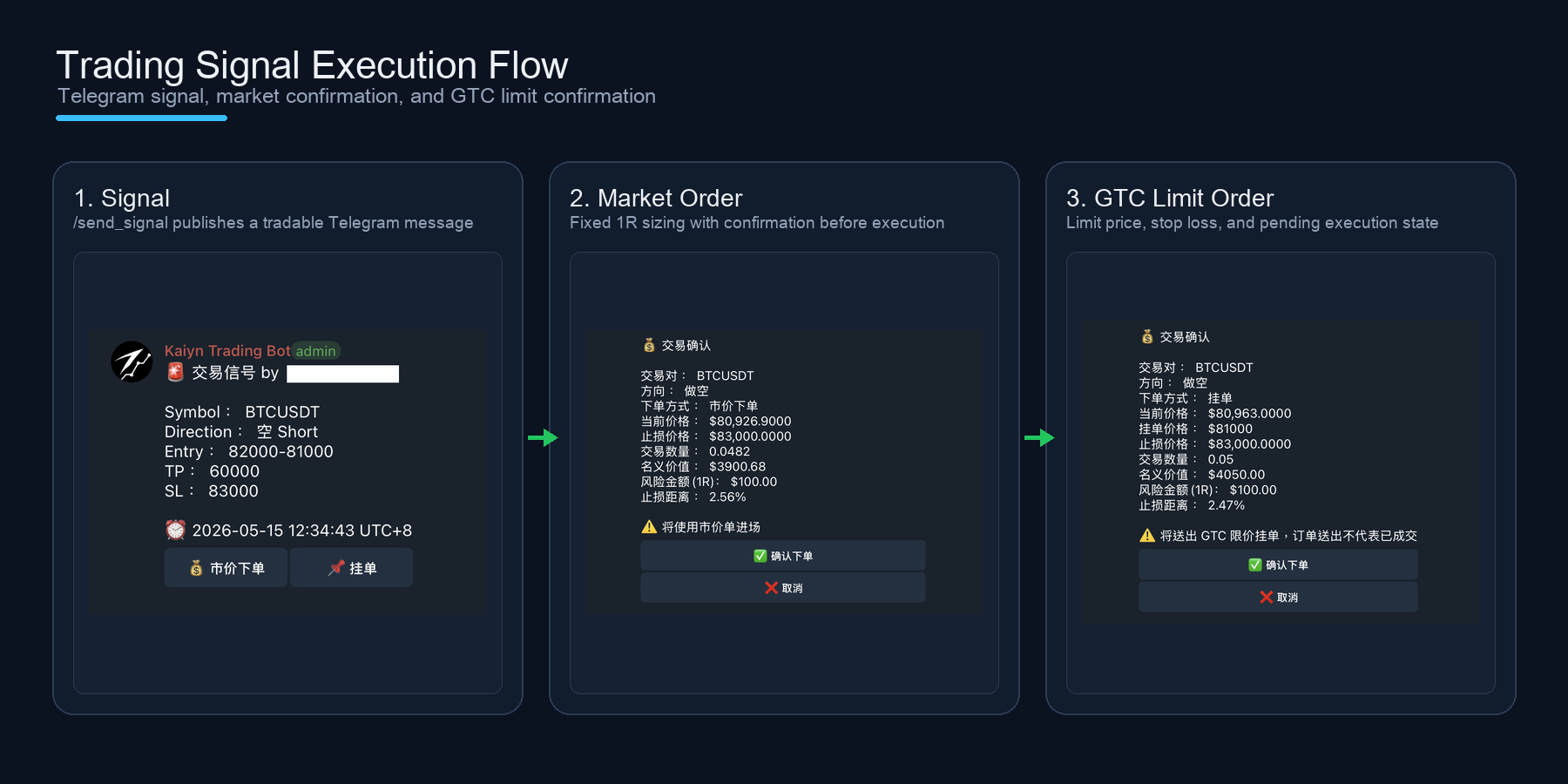
- Confirmation previews
- Market and GTC limit flows
- Deterministic client order IDs
- Row locking and reconciliation
Kaiyn Capital · Execution Infrastructure
A confirmation-first Telegram workflow for Bitget USDT-FUTURES, designed around explicit risk limits, deterministic order identity, and operations that can be reviewed.
Execution workflow
Telegram actions create persistent pending orders. The system calculates size, validates exchange constraints, then validates again before sending a confirmed order to Bitget.
Engineering pillars
The design treats safe state transitions and recoverable operations as part of the product, not as infrastructure added after launch.
Persistent state and exchange reconciliation are used to reduce ambiguous or duplicated submissions.
Order sizing and exchange constraints are checked before a request reaches the submission boundary.
Health checks, audits, retention, and restore procedures keep operating state visible and recoverable.
Operational evidence
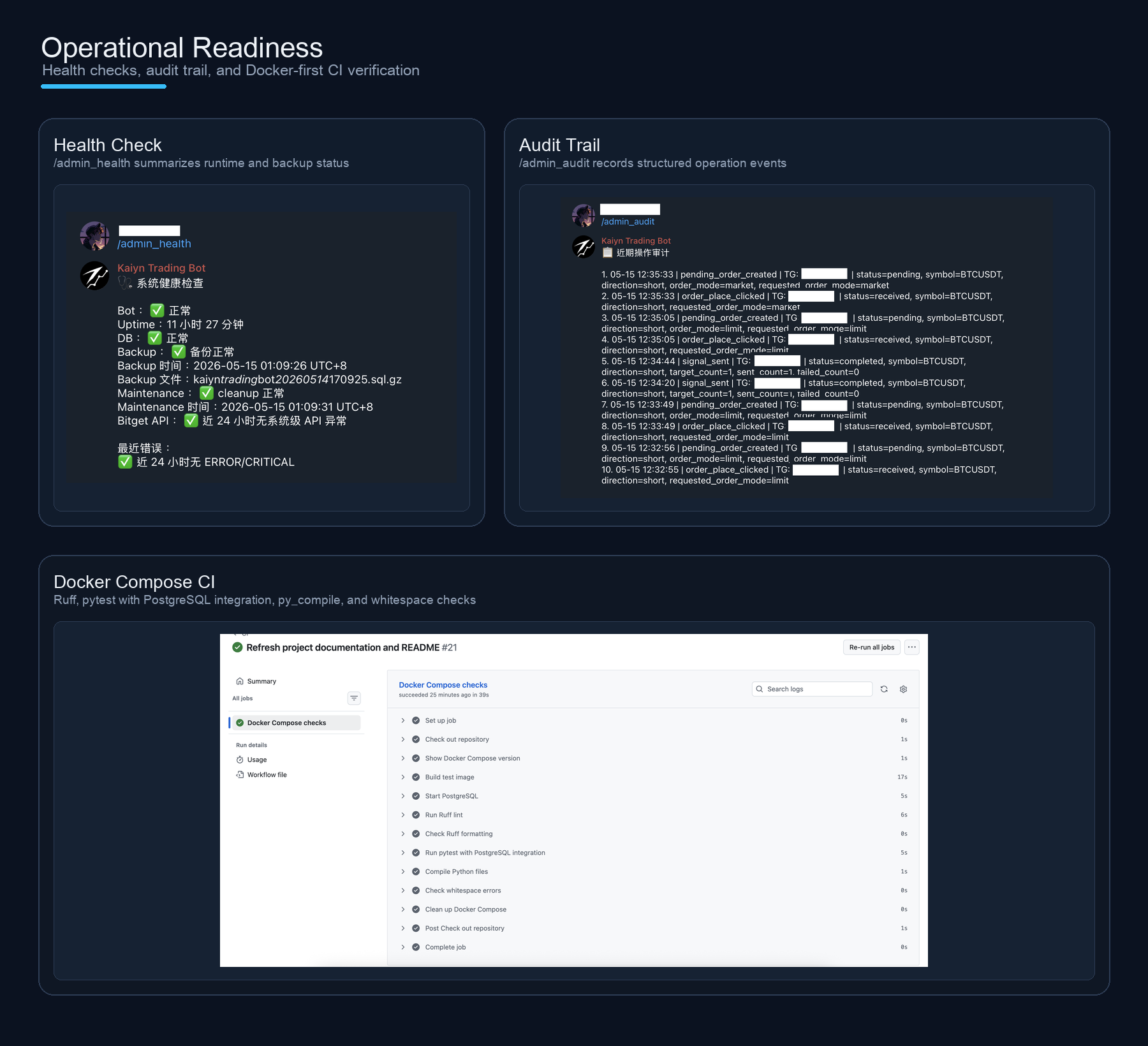
The same Telegram interface used for execution also exposes concise operational context to administrators.
Inspect database, backup, cleanup, and Bitget API status from Telegram.
Order, channel, admin, and system actions are recorded for later review.
Retention, local dumps, encrypted offsite backup, and restore runbooks are included.
Technical foundation
Python 3.11 · python-telegram-bot · Bitget REST API · Fernet encryption
PostgreSQL 16 · SQLAlchemy asyncio · Alembic · Docker Compose
Ruff · mypy · pytest · GitHub Actions · GHCR · VPS deployment
Documentation
The repository documents command usage, execution state, deployment, and recovery procedures.